

The process of risk prioritisation is affected by several factors including; risk attitude, risk sensitivity, resource availability, risk severity, and risk manageability.
Prioritisation by Attitude
An organisation’s risk attitude is made up of a combination of its risk appetite, risk tolerance, and risk threshold. These three attributes are defined as:
- Risk Appetite – The degree of uncertainty an entity is prepared to accept in pursuit of its objectives.
- Risk Tolerance – The degree, amount, or volume of risk impact that an organisation or individual will withstand.
- Risk Threshold – The level of uncertainty or impact at which a stakeholder will have a specific interest. Below the risk threshold, the stakeholder will accept the risk. Above the risk threshold, the stakeholder will not accept the risk.
An organisation with high risk appetite but low risk tolerance will tend to prioritise its risk responses around anticipated impact rather than the likelihood of occurrence — often because it operates in unstable or high-threat environments where risk events are a given. Conversely, an organisation with low risk appetite but high risk tolerance (an unusual combination) will focus on minimising the probability of occurrence, and put less effort into managing impact.
Risk attitude is also shaped heavily by industry sector. In oil & gas and mining, where personnel safety is paramount, the accepted threshold for loss of life is typically around 1 in 10,000 per year. In security services and defence, where fatalities are an accepted higher-frequency part of the job, the acceptable threshold can be as high as 1 in 100 per year. In other sectors, risk attitude and thresholds are shaped instead by finance, health & safety, quality, production, environmental, social, and legal risk categories.
Prioritisation by Sensitivity
Sensitivity analysis determines which risks will have the greatest potential impact on a project, by comparing each risk’s uncertainty level against all others — effectively, how much a risk’s outcome changes in response to a change in its inputs. This applies both to the uncertainty in occurrence and the uncertainty in impact, and it leads to two distinct types of follow-up action: risks sensitive to occurrence need further assessment to understand which variables most influence probability; risks sensitive to impact need multiple response plans to control the conditions driving that impact.
Where uncertainty runs both positive and negative, risks can be plotted on a tornado diagram — risks with the greatest uncertainty are the least stable, those with the smallest are the most stable.
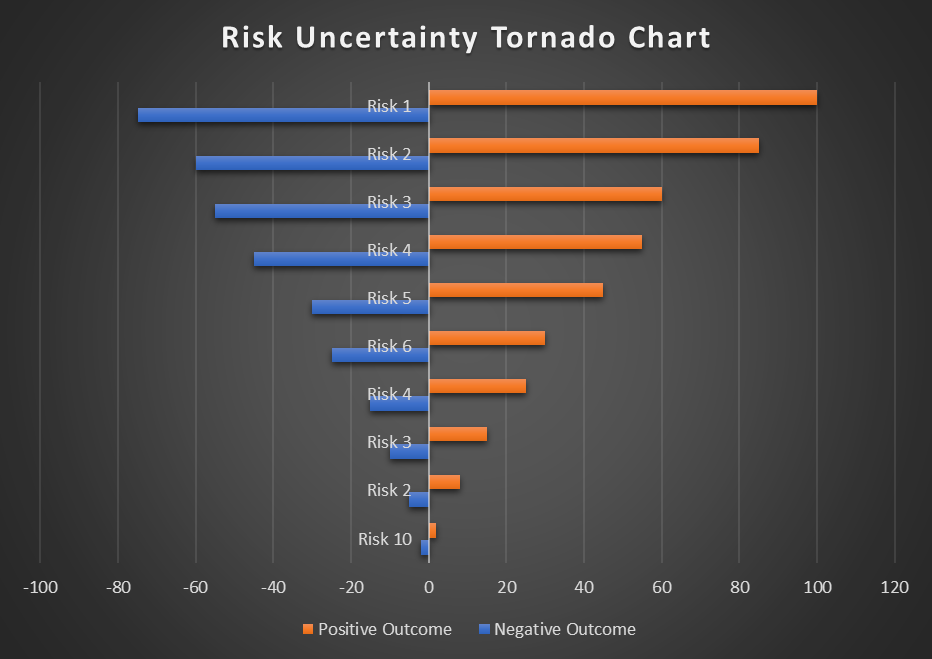
Where uncertainty runs in only one direction, risks can instead be arranged on a Pareto diagram, from most to least sensitive.

As an example, consider a project trying to determine which work packages contribute most to uncertainty in total project cost. This requires estimating the cost uncertainty of each package individually, then determining how packages are associated with or dependent on one another — since total cost uncertainty is driven not just by each package’s own uncertainty, but by how much each package affects, and is affected by, the others. A construction project’s cost, for instance, is typically far more sensitive to outdoor activities (weather-exposed) than indoor ones. Ranking work packages by relative sensitivity — not absolute value — tells a project manager where to focus attention first.
Prioritisation by Resource Availability
This isn’t something risk managers should be doing by choice, but sometimes it’s unavoidable: when assessment or control requires specialist resources — people, materials, or equipment — that aren’t readily available to the project. In these cases, the affected risks go on a monitoring list until the resources become available, with the response plan revised if severity or manageability changes in the meantime.
Prioritisation by Severity
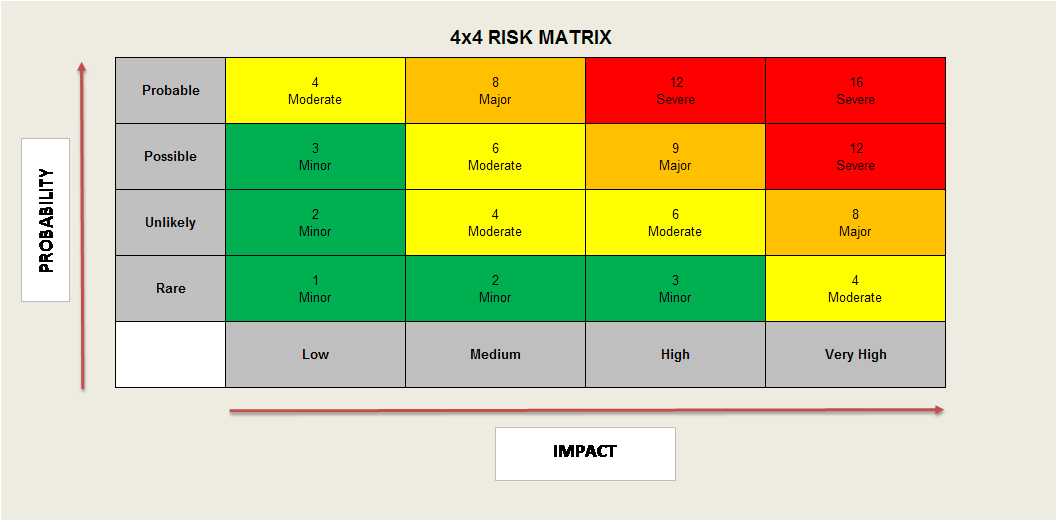
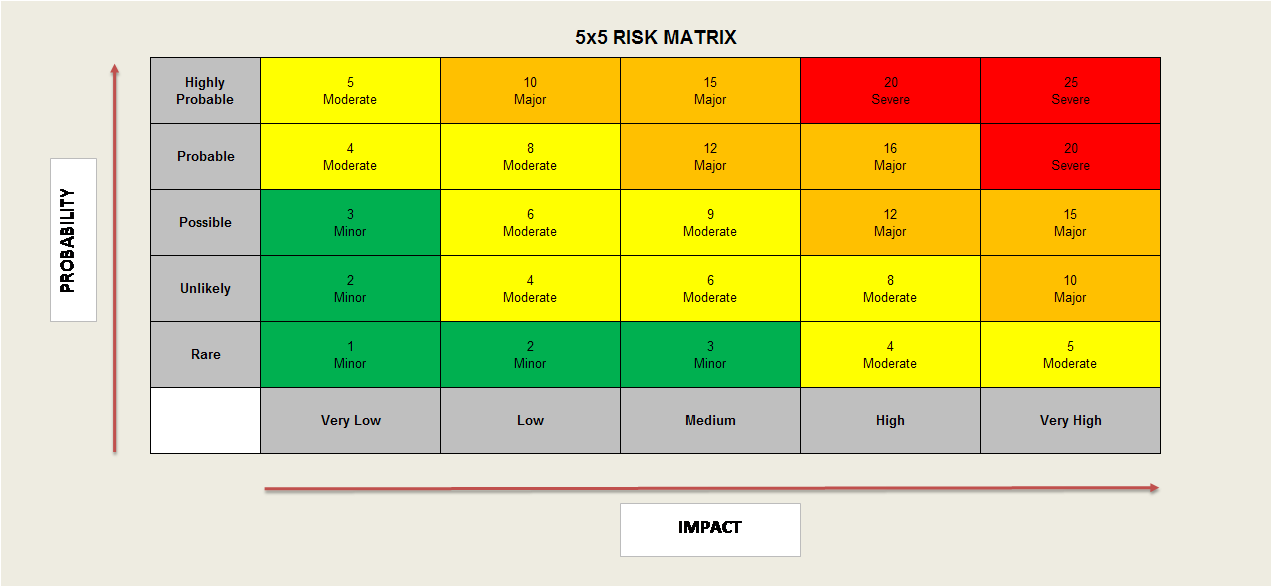
More often than not, risks are prioritised by severity: the higher the probability and the higher the impact, the higher the priority. Severity is initially determined qualitatively, typically using a probability/impact matrix that multiplies a risk’s probability rank by its impact rank. As discussed in our post, Risk Matrix Sizing: Does size really matter?, the size and format of the matrix make little practical difference, as long as the ranking ranges and definitions are applied consistently. Whatever size matrix you use, the product of probability and impact will always tell you how severe a risk is relative to others measured the same way. In most cases this is enough to establish response priority, though some risks may still warrant further quantitative analysis for a more precise priority level.
Prioritisation by Manageability
While prioritisation by severity may look like the best option, this is often not the case. Consider a risk ranked at very high severity expected to occur in two years’ time with several tried & tested response actions available, compared to a risk ranked at low severity expected to occur within the next few weeks with limited untested response actions available. Which one would you prioritise? You would prioritise the one that is expected within the next few weeks. This is because this risk has a very low manageability rating.
Risk manageability is a function of expected occurrence date and the number of response actions available to control the risk. A risk expected within the next few weeks, with only a limited number of available response options, would be considered “imminent” with “very low” manageability — and its priority should be raised accordingly, so that whatever options exist get implemented urgently. The lower the manageability, the higher the priority should be.

Project Risk Manager’s configurable risk matrix and manageability tracking build these prioritisation principles directly into your risk register. See how it works or book a free demo. The Basic plan is free for up to two active team members, so it costs nothing to try.
Want to see how severity and manageability ranking works in practice? Get in touch — we’d be happy to help.